TL;DR
- ·Pest control busy season calls are the surge of new customer calls that comes with each seasonal wave: termite swarmers in spring, stinging insects in summer, rodents when the weather turns cold.
- ·Plan from last year's call log, not from memory: count inbound calls by week, write down your triage order and get any new phone setup working before the surge, not during it.
- ·Lani AI answers every call in under a second, 24/7, covers the moments when a second line rings and books straight to your scheduler. 7-day pilot, completely free. If you decide to move forward, there's a setup.
What happens to pest control calls in the busy season?
In the pest control busy season, calls arrive in bursts that a 1 or 2 person office can't answer as they come in, so more of them ring out, sit on hold or land in voicemail. The work hasn't changed. The timing has: many homeowners notice the same problem in the same warm week, and a lot of them call within the same few hours.
1 person on the phones
- 13 calls ring within 10 minutes
- 2The first one gets answered
- 3The other 2 reach voicemail
- Monday starts with callbacks to people who've moved on
Every call answered
- 13 calls ring within 10 minutes
- 2Each one is answered on the first ring
- 3New customers get booked onto real routes
- Monday starts with a list of booked visits
The shape of the season depends on where you work, but the pattern in many regions is familiar. Termite swarmers show up as spring warms up, ants and stinging insects build through summer, mosquitoes follow the rain, and rodents move indoors when the nights turn cold. Each wave brings new customers who've never called you before, and they're the callers least likely to wait. Our post on pest control missed calls covers how to count what you're losing across the whole year. This one is about the weeks when the problem is at its worst.
The trap is judging your phones by an average week. A month where you answered most calls can still hide a few Saturdays when the new callers mostly went to voicemail, and those were the days that mattered.
When does the pest control busy season start & how do you see it coming?
It starts when the weather turns, so the most reliable forecast is your own call history from last year, not a date on the calendar. Export 12 months of inbound calls from your phone provider and count them by week. The surge tends to line up with the same stretch of weather each year, so last year's start is a good first guess for this year's.
Then look at what the calls were about. If you log a reason for each job, sort last season's new bookings by pest and by week. You'll see which wave hits first, how long it lasts and when the next one stacks on top of it. That tells you what to prepare: termite inspection slots in spring, a stinging insect script for summer, rodent questions for autumn.
The trap is planning from memory. Everyone remembers the worst week, and nobody remembers the 2 quieter weeks before it when the calls were already climbing. By the time the surge feels obvious, you've usually been missing calls for a while.
Step by step
Build your busy-season forecast in 4 steps
- 1
Export 12 months of inbound calls
Your phone provider can usually give you a call log with dates and times.
- 2
Count them by week
Mark the week the count starts to climb, not the week it peaks.
- 3
Sort last season's new bookings by pest & week
You'll see which wave hits first and when the next one stacks on top.
- 4
Set your prep date before last year's climb
Scripts, slots and phone coverage should be ready a couple of weeks before it.
Why doesn't hiring for the busy season fix the phones?
Because a seasonal hire takes weeks to learn your service areas, prices, guarantees and scheduling rules, and the surge doesn't wait for them. By the time a new office hire can book a termite inspection without asking anyone, the spring wave may be over.
There's a timing problem too. Busy-season calls don't arrive evenly through office hours. They pile up on a Monday morning after a warm weekend, in the late afternoon when people get home and find wasps by the door, and on Saturdays. A second person from 9 to 5 helps with some of that and none of the evenings. A traditional answering service covers the hours, but it usually takes a message rather than booking the visit, and a message is a callback you still have to make in your busiest week. Our after-hours answering service guide compares the options for the hours your office is closed.
Covering the surge, compared
| Option | Ready in week 1? | Covers evenings and Saturdays? | Books the visit? |
|---|---|---|---|
| Seasonal office hire | Takes weeks to learn your rules | Only the hours you schedule | Yes, once trained |
| Tech pulled off the route | Yes | Only if they're on the phone | Yes, at the cost of treatments |
| Traditional answering service | Yes | Yes | Usually takes a message |
| AI receptionist | Once your rules are set up | Yes, 24/7 | Yes, into your scheduler |
The trap is pulling a tech off the route to answer the phone. It feels like a fix, but every hour on the phone is an hour of treatments not done, in the only weeks when the schedule is full.
Which busy-season calls should get answered first?
New customers with an active problem come first, because they're the ones who'll call the next company if you don't pick up. A homeowner with wasps nesting by the front door, mice in the kitchen or swarmers in the living room is ready to book now. An existing customer moving a quarterly visit usually isn't going anywhere and can wait an hour for a callback.
Incoming calls
- All sorted
Answer and book now
- Wasps nesting by the front door
- Mice in the kitchen
- Termite inspection, closing next week
Callback within the hour
- Moving a quarterly visit
- Question about an invoice
Write the order down so everyone who answers the phone uses the same one. A simple version: stinging insects near a doorway, then rodents inside the home, then termite activity or a termite inspection with a closing date, then new routine service, then reschedules and questions from existing customers. Our post on termite inspection booking covers the closing date calls in detail.
The trap is promising same-day service to everyone because the caller sounds upset. In the busy season, a same-day promise you can't keep costs more than an honest next-day slot. Decide in advance which situations justify squeezing in a visit, and let the rest book the next open route day with a clear arrival window.
Template
Your busy-season call order
Pin this by every phone, or hand it to whoever sets up your line.
1. Stinging insects near a doorway.
2. Rodents inside the home.
3. Termite activity, or a termite inspection with a closing date.
4. New routine service.
5. Reschedules and questions from existing customers: callback within the hour.
6. Same-day visits only for [your list]. Everyone else gets the next open route day with an arrival window.
How does an AI receptionist handle a busy-season call surge?
It answers each call as it comes in, asks the questions you've set, books the visit into your scheduler and sends the calls that need a person to your staff, so the surge doesn't turn into a pile of voicemails. The live AI receptionist page says Lani AI answers in under a second, around the clock, including nights, weekends and the moments when a second line rings. When a call does slip through, it texts the caller back within seconds.
Here's how a typical busy-season call goes. A homeowner says wasps are flying in and out of a gap by the porch light. It asks where they're seeing them, whether anyone's been stung and the address, checks that the address is in your service area, offers the next open slot on the right route and confirms it by text. The live site says confirmed appointments land in your booking system in real time and each call and its outcome is written to your CRM, so the office starts the next morning with a list of booked visits instead of a list of callbacks. Our walkthrough of an AI answering service for pest control goes through more calls step by step.
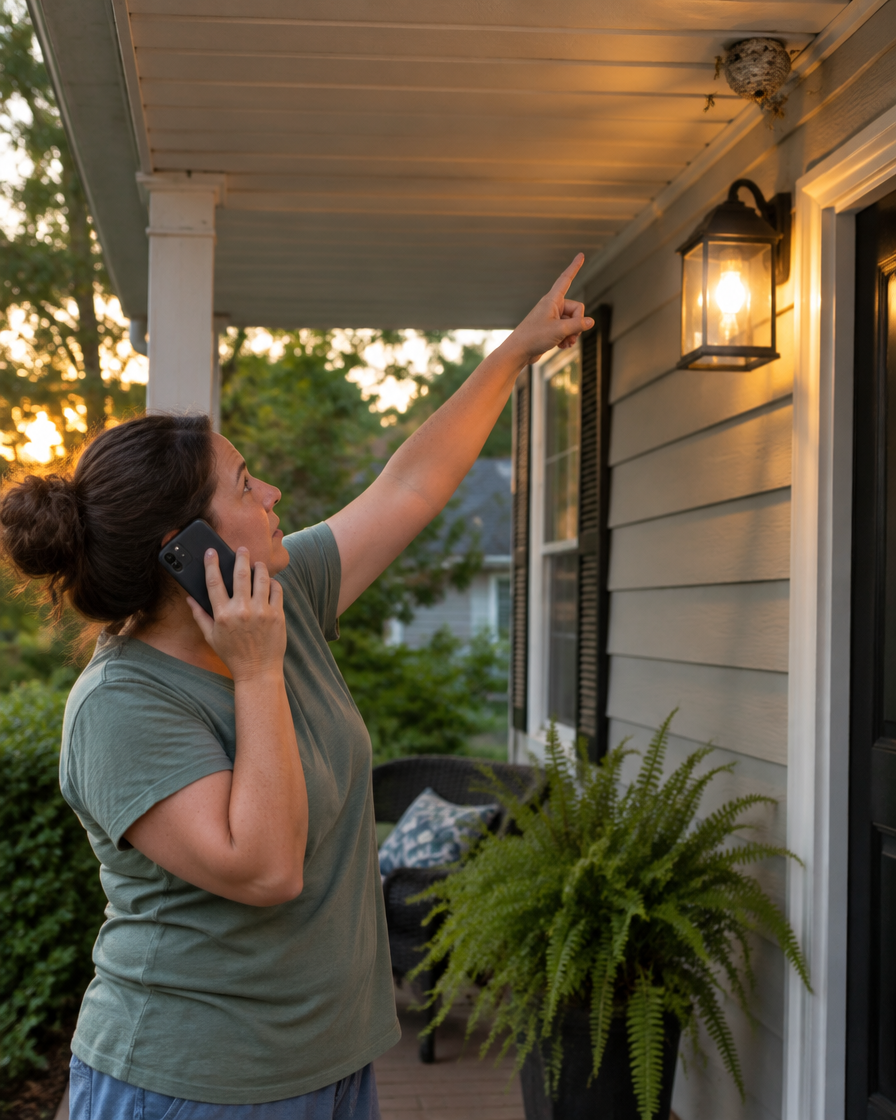
The trap is assuming any AI tool can do this out of the box. It only books well if it knows your service areas, visit lengths and which techs cover which days. Ask any vendor, us included, to show you a busy-season call booked into your real schedule, not a demo calendar. If you have customers who'd rather speak Spanish or another language, test that too: the live site says it answers in 30+ languages.
What should you set up before the busy season starts?
Set it up in the quiet months, so the first busy week is a test you've already passed, not the first time the system is used. Most of the setup is the same information you'd give a new office hire: your hours, service areas, the pests you treat and don't treat, how long each visit type takes and which tech does what.
Then add the rules that matter most when the phones are full. Which calls transfer to a person right away, and to whose phone. What it may say about price, which is often nothing beyond "the technician will confirm the price after the inspection." How it handles a caller who wants same-day service when the routes are full. And what it does with safety questions about a treatment, which should always go to a licensed tech. The live site says it transfers calls to your staff with the full context of the conversation attached, so decide where that handoff line sits before the season, not during it.
Last, decide how it fits next to your current phones. A common starting point is to forward only overflow and after-hours calls, so your office still answers what it can and the AI picks up the rest. Our guide to AI receptionist appointment scheduling covers how the calendar connection should work. The trap is a setup nobody owns: give 1 person the job of reading transcripts every day for the first 2 weeks and fixing what's wrong.
Checklist
Your pre-season setup list
- Hours, service areas and the pests you treat and don't
- Visit length for each job type
- Which tech covers which days and areas
- Which calls transfer right away, and to whose phone
- The exact line it uses about price
- What it offers when the routes are full
- Treatment safety questions go to a licensed tech, every time
- 1 person reads the transcripts daily for the first 2 weeks
How do you test it before your next busy season?
Run a pilot on your real line a few weeks before last year's surge started, then call it yourself the way busy-season callers do. Make 5 calls: a homeowner with wasps by the front door on a Saturday evening, a family with mice in the kitchen who wants someone this week, a real estate agent who needs a termite inspection before a closing date, an existing customer moving a quarterly visit, and a caller who asks whether a treatment is safe for their pets, to make sure it hands that one to a person.
After each call, check 3 things: did the record have the right details, did the visit land on the right route at a time you'd accept, and did the calls that needed a human reach one. Then call from 2 phones at the same time to hear what happens when a second line rings. If you'd rather start smaller, a missed call text back is the minimum for the busy season, but a text isn't a booked visit.
That's the case for a pilot before the surge, not during it. The 7-day pilot is completely free. If you decide to move forward, there's a setup. See how the AI receptionist handles your calls, or put last season's numbers into the ROI calculator first. How well you handle pest control busy season calls next spring is decided by what you set up in the quiet months.
Frequently asked questions
When does the pest control busy season start?
It depends on your region and the weather, so the best forecast is your own call log from last year. Count inbound calls by week and note where the climb starts.
Should I hire extra office staff for the pest control busy season?
A seasonal hire takes weeks to learn your service areas, prices and scheduling rules, and a 9 to 5 shift misses the evenings and Saturdays when calls pile up. It can help, but it rarely fixes the phones on its own.
Which busy-season pest calls should be answered first?
New customers with an active problem, like stinging insects near a doorway or rodents inside the home. Existing customers moving a routine visit can usually wait an hour for a callback.
Can an AI receptionist handle a pest control call surge?
It answers each call as it comes in, asks your questions, books into your scheduler and transfers the calls that need a person. It only books well once it knows your service areas, visit lengths and which techs cover which days.
When should I set up phone coverage for the busy season?
In the quiet months, with a pilot a few weeks before last year's surge started. The 7-day pilot is completely free; if you decide to move forward, there's a setup.
Ready when you are
See if Lani AI is right for your business.
7-day pilot, completely free. Live by the end of this week.